

The Human Chicken Farm
On the first day of the 3rd millennium, January 1, the year 2000, the NYPD responded to a call about a doomsday cult committing a mass suicide in an underground bunker in New York City. This cult was thought to be connected to Y2K, the idea that all computers would reset at midnight due to a programming bug and plunge us into a new dark age. Spoiler: it didn’t happen. But what the NYPD found in this bunker was even stranger than a doomsday suicide cult.
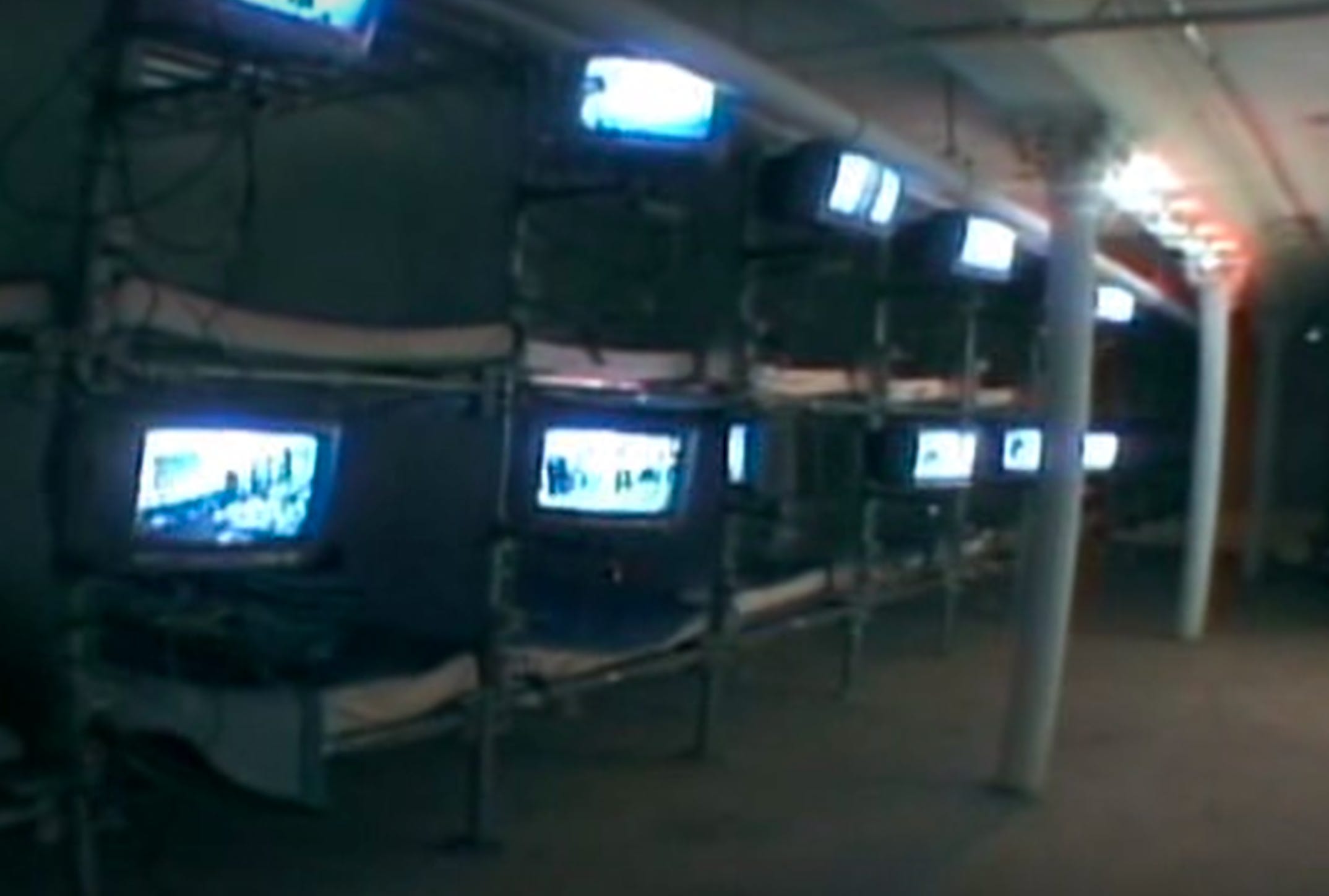
What the police found was a simulation of ordinary civilisation wired up with hundreds of cameras and watched by an unseen mastermind: a dining hall, a shower room, a church/temple, a gun range with hundreds of guns, and a ‘pod-hotel’ where occupants lived in bunkbeds wired up with webcams and TV monitors where they could watch one another 24/7. This bunker was not a doomsday cult but rather an unregulated experiment by an eccentric Web 1.0 millionaire called Josh Harris.
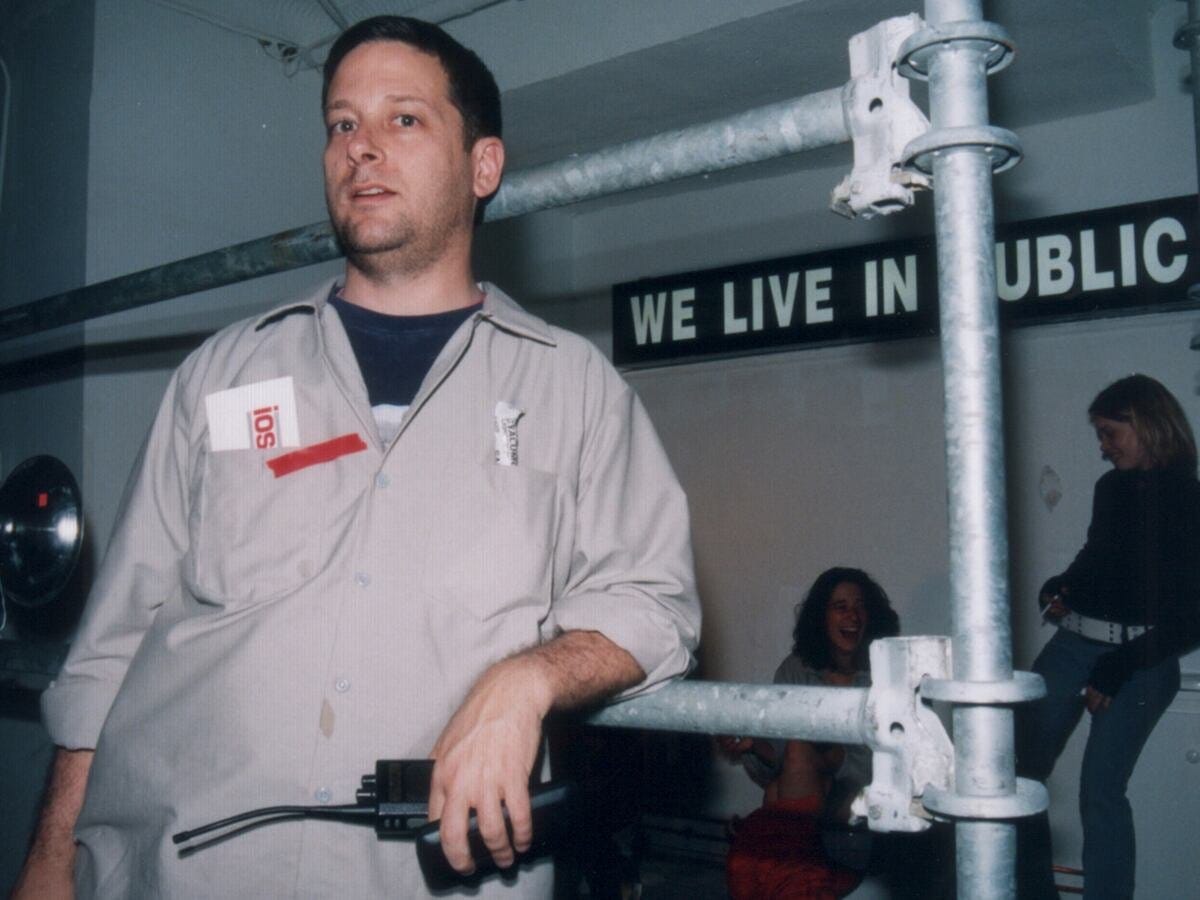
Josh Harris is allegedly the first internet pioneer to make a million dollars in New York City off the internet. He made his millions with a digital advertising company called Jupitor Communications, which he sold for 85 million dollars, and then plunged all his money into this series of bizarre experiments/performance art pieces. He started the first internet television website called ‘pseudo.dot.com’, which was an early forerunner of YouTube. The point of the experiments was probing what life would be like once this technology got better and we would be online all the time. This particular experiment in the bunker was called ‘Quiet: We Live in Public’, and there’s a great documentary by the same name if you are interested, and it was billed as an experiment in ‘future living’ or life under ‘internet conditions’. Harris really understood digital technology and what life would be like once this technology got better.
So in the experiment, he got one hundred volunteers, mostly artists and creative types, and subjected them all to a 323-questionnaire psychological evaluation to map out their fears, hopes, histories, and traumas, whether they were an addict, whether their parents divorced, whether they were religious, etc., to identify what buttons to press to manipulate them for the cameras in the bunker. He actually hired a Middle Eastern interrogation expert and psychologists to try and psychologically break the participants during the experiment.
Everyone was recorded in the bunker 24/7 by over 100 cameras, even in showers, toilets, etc., and they could watch each other on the TV monitors. Everything was free—the food, accommodation, and guns, except the video footage, that Harris owned. Their lodgings were also based on how interesting they were on camera; basically, the more interesting citizens got better lodgings, and any that were boring or too moral got the boot from the experiment. It was natural selection of the biggest attention seekers. Harris created a high-drama, high-chaos environment and then profits from the resulting spectacle.
As you can imagine, the wheels came off pretty quickly. – sex, violence, and people constantly performing for the camera’s reported losing all sense of who they were, like puppets on a string and feeling incredibly lonely despite being surrounded by people. As Harris says in the documentary, the more you get to know people in this space, the more lonely you feel. The only moral norm in the bunker was left to be interesting on video, and as one participant described the whole thing, ‘The absolute freedom turned them all into beasts.’ Another participant described life in the bunker as somewhere between a 70s commune and a fascist surveillance police state, which is as good a description of the internet as you’re going to get.
So despite getting shut down on New Year’s Day, the experiment confirmed Josh’s theory that by setting up the environment with technology, you could exploit the human need for connection and attention and basically get people to do anything. As one organiser described, ‘If you walk up to someone and say take off your pants – they won’t do it, but if you walk up with a video camera and say, ‘Take off your pants,’ they’ll do it.’ The camera holds the power of the audience, and I think in a world without God, the audience is as close as you get.
Harris recognised that a generation of young people who grew up watching TV, at some point, would want to be in the TV and that the internet was going to make this possible, and that once we went into the TV it might not be so easy to get out. As he says in the documentary, “Andy Warhol was wrong; people don’t want 15 minutes of fame in their lifetime, they want it every day.” So in this experiment, Harris basically predicted life in the digital age under social media.
By offering everyone the opportunity to become a celebrity and to get an audience, whoever created the digital world would hold the keys to modern people’s deepest desire—to be seen and to be loved. Harris correctly saw we were heading into a world where a person’s value would be determined by how many people would be willing to watch them on a screen, and he saw the best place to be in this coming world was not in fact the one on the screen or the one watching the screen, but the one behind the screen pulling the strings. Harris actually told this to CBS during a television interview, saying the internet would beat the legacy media because they would be the ones ‘programming people’s lives’.
So after this experiment, he did one more where he invented the entire concept of live-streaming in the early 2000s, filming every moment of his and his girlfriend’s life. But then he disappears; first he buys an apple farm, and then he moves to Ethiopia. Then the documentary is released in 2009; he came back on the scene in the 2010s, talking about a new prediction for the future, which he relates to AI and the singularity, but which he argues is the technological endgame of this whole thing, what he calls ‘the human chicken farm’.
In the quiet experiment he showed how networked living, where everyone was always connected, turned people into a human hive, destroying their individual conscience and hence their ability to control their behaviour, but that this isn’t the end point of the technological system. He says the endgame is that in the same way that chicken farmers control the lights and artificial environment of a factory farm to grow optimal chickens for slaughter, with a completely networked society, this could now be done to human beings. I think what he’s talking about is the same thing as what Paul Kingsnorth calls the machine, but what he is describing is how the machine is shaping the scope of our moral imaginations. As Harris says in the documentary, “World War 2 was the most important event of the last century, and the most important event of the next century will be World War 3, and it will be man against machine.”
He made this prediction in 2016, ten years ago. According to my research, he was right. Technology seized the means of human production. As Harris predicted, the technology got better and better; high-speed internet, smartphones, and social media made it possible to always be online, and for the values and standards of those who created the digital worlds became the standards by which we live our lives under internet conditions. This is a profound, albeit silent, revolution. While Harris had people dancing for their crumbs of attention in that underground bunker in the year 2000, one need only open their phone today to see millions dancing for their rations of attention all over the world. A tiny number of companies seized the means of media distribution in the new media environment and hence determined what people see and hence who they become.
I have argued elsewhere that this was the AI apocalypse and that it already happened, when we moved from a culture curated by human judgement to a culture curated by machine learning algorithms. This is a profound transformation, and it means the values of the authors’ virtual worlds leapfrogged the non-virtual world, which happened so seamlessly hardly anyone noticed. Yet, at the same time, everyone knows something is wrong, something fundamental has changed, and as is frequently said online, ‘the world you grew up in no longer exists.’ I think Harris is right; we are already in the chicken farm, and as he argued, the door is rapidly closing behind us.
The Closing Door
What would it mean by the door of the chicken farm to close on us permanently? For us to become trapped in the machine for good? Harris himself relates this idea that we are approaching a kind of event horizon with the machine in the AI singularity. That once they make an AGI that can recursively self-improve, it will just turbo-charge its own intelligence, and we’ll be helpless, and it’ll either vaporise us or put us in a human zoo or something. But I think this is nonsense. It’ll be interesting to see if the non-profitable AI companies continue with this rhetoric after their trillion-dollar IPOs (or if their bubble bursts first), but that’s maybe a different story.
But if you accept my hypothesis that under conditions of digital culture we are indeed in the human chicken farm culturally at this point, there is another way the door could close on us for good. This is what I call in my research the ‘vicious feedback cycle of moral degradation’. In brief, the technological system, digital culture, automates sin and vice for profit; people who sin and develop vices get rewarded socially, so other people copy these behaviours to get the same rewards, and basically human character goes to hell in a handbasket. It’s like a mimetic behavioural disease, where moral failures are rewarded and hence maximised. There is something incredibly demonic to this as well, by the way, like the automation of sin is basically building a highway to hell. But again, I’m optimistic, so I think this is going to backfire in the long run, which I will talk about in the next section.
So in my research, I frame the internet as a ‘formative technology’. In other words, the point of the internet is to form desires and interests in the user that they didn’t have before using the internet. If you have a hoover to clean the house, the hoover helps you achieve your goal of cleaning more efficently. But the hoover doesn’t try and give you new goals. But on the internet, while messaging and posting, consuming, etc., this cognitive scaffolding is trying to change the goals which you are pursuing during the interaction, to goals that are more suited to whoever is paying the highest price. The economic reason for this formative mission is the advertising business model.
The Web 1.0 guys, like Josh Harris, went bankrupt after the dot-com bubble in 2001 because a lot of money was pumped into the internet but they didn’t have the business model to generate enough revenue to pay back the investors. The internet always had this business model problem: how were they going to make money on this thing? It’s amazing; it’s going to change everything, but where is the money coming from? So in Web 1.0, when the investors wanted their money back, it was game over. But the next generation of Web 2.0 companies, like Google, Meta, etc., solved this business problem of how to make money with the internet through advertising.
And there’s an ideological component to all this. Jaron Lanier, inventor of virtual reality, argues a lot of these internet pioneers were hippies, albeit not the Woodstock hippies but computer hippies (the internet also started in the 60s/70s). So they wanted information to be free but also needed tonnes of money to build this computer utopia, and so advertising was the compromise. You give the digital world to users for free, and you profit from the advertisers on the backend. But as Ethan Zuckmann, the inventor of the pop-up ad, said, this business model is the ‘original sin’ of the internet. Due to this business model, the user of the internet isn’t the customer; the advertiser is the customer, and hence, the users’ behaviour is the product. As often said today, if you aren’t paying for the product, you are the product. And as Jaron Lanier puts it, the product the social media companies are selling is the gradual, imperceptible change in your action and perception. ‘ (He describes these Web 2.0 companies as behavioural modification empires).
So this combination of digital technology and advertising creates a race to develop the most powerful technologies for influencing human behaviour ever created. How do they do this? The same way Harris did in the Quiet experiment, you map out people’s personalities and histories and use that information, delivered through an apparently neutral environment, to adaptively influence the user. So the digital medium evolved not to serve the users but to serve advertisers; the money earned was reinvested not into the content but into making the medium better at modifying behaviour.
They borrow a lot of these behavioural design techniques from 20th-century behaviourist psychology like B.F. Skinner. Skinner famously came up with the ‘Skinner box’, or ‘operant conditioning chamber’, which was a controlled environment (often a box) where an animal is rewarded for taking the actions the experimenter wants and punished for taking those the experimenter doesn’t want. Over time the animal is conditioned by the system of rewards and punishments to behave the way the experimenter wants the animal to behave. Using this simple reinforcement learning mechanism, Skinner could get pigeons to play ping pong and guide missiles. If you are interested in how they do this, a great and disturbing book is ‘Hooked’, by a guy called Nir Eyal, who studied at the Stanford Behavioural Design Lab.
Again, we’re thinking about the chicken farm; the farmers have set up this behavioural factory to reward users for engagement (posting, liking, commenting)—basically anything that keeps you in the digital world—and then punishment for not participating, like FOMO, not getting likes, social failure, ostracisation, etc. Over time, the more you participate in that culture and come to internalise those standards and look at your own life through those standards, the better a user you are for them. The scope of the users’ moral imagination comes to be determined by the technological environment.
A good example of this was in Louis Theroux’s manosphere documentary; he interviews a streamer, HS TIKKY TOKKY, and asks him, ‘Why don’t you just do good things online?’And HS’s reply was, “If I just done good things, I would never have blown up on social media in the first place.” The standards of the digital attention game have trumped his own conscience basically. But at least he’s still kind of aware that there’s a difference between the good and successful online, but that might not be the case for long.
In a way the digital culture, like the bunker, is simply doing what every culture does; it rewards behaviours the social order wants and punishes behaviours it doesn’t want. In offline cultures this would be the law: if you kill or steal, you go to jail, which is a punishment. But the problem is in the digital world it is rewarding behaviours that would have been considered wantonly immoral even just a few years ago – rewarding lust, greed, gluttony, envy, wrath, and pride; sin-maxxing. It’s also doing so with automated technology rather than human judgement, and I suspect it’s easier to optimise for vices because they have a clear utility function and hence are easier to code (and more profitable).
The companies with the advertising business model have hard-coded this morality into their platforms and automated it across billions of people in a way that is beyond any legal system, and so functions as the de facto laws and norms of the virtual world. What are the consequences of this new digital culture? In these virtual worlds, like the bunker, if the only norm is to get attention, then moral norms and taboos become frontiers for attracting and gaining more attention. An example of this would be Bonnie Bleu, who received an absurd amount of attention and a Channel 4 documentary for having sex with one thousand men in a day. Even secular people recognise these types of things are bringing us closer to the wraith of God. But because of this attentional system, it actually makes sense to do this kind of stunt; Bonnie Bleu is a product of this attentional system.
In my thesis, I compare this digital attentional architecture to the Roman Colosseum. When it first opens, seeing one guy fight another is exciting, but then it has to be two versus one, and then a one versus a lion, and then you’re having pitched sea battles and killing thousands in grotesque theatrical executions. It’s built into the human reward system in the brain that adapts to thrills, and so what was thrilling becomes boring, and so you have to go to something more thrilling to up the ante, what is called ‘hedonic adaptation’. It’s the basis of addiction and the ramping up of addiction. When you operate in hedonism, you end up without surpassing moral norms in the pursuit of thrills. You get caught in this vicious feedback cycle basically where the desires ramp up until you then do cross moral boundaries, which you may not have been aware of. But because people are competing in the digital colosseum, what’s successful gets more extreme, other people copy those who succeed at getting attention, and the whole thing tilts towards crazy town. This is the start of the vicious feedback cycle of moral degradation.
So rather than a rogue AI turning us all into human soup, what I think the door of the chicken farm closing would be is when the collective scope of our human moral imagination comes to be determined by this attention machine. When the machine becomes the dominant formative power of forging the consciences of future generations. Because then we wouldn’t even know what we have lost – we play the game to win and in winning, we lose, because it was not the right game to be playing in the first place. Success in this cultural regime leads to moral corruption and that is a game ender.
And yet, with all that being said, I’m incredibly optimistic. The important thing is we are not chickens in a farm or rats in a lab; we are human beings made in the image of God with free will. So in the final section, I’m going to talk about the ‘silver lining’ of the chicken farm, and I like that metaphor because a silver lining comes when we see the light of the sun shining through the edges of a dark cloud. And the silver lining only happens because dark clouds don’t destroy the sun; the sun, as Dante and Plato employ, is often a metaphor for God. So I don’t think the machine or the chicken farm can destroy God, or change good to evil or evil to good and and so the project is destined for failure. Another Tower of Babel, we will get to watch falling in realtime.
The Silver Lining of the Chicken Farm
So there is an irony here, that without the internet, something that I have essentially claimed to be evil, I wouldn’t be a Christian. I wouldn’t know God, and hence reality. The silver lining of the chicken farm, because we are not chickens— as this corrupt system is so obviously closing around us and basic morals are degrading, we start to look around for the truth and for a better way of life. And I actually think this is going to result in some tremendously positive outcomes: (1) the end of secularism, (2) a return to education as the cultivation of virtue, and (3) we will see digital saints emerging within the machine.
(1) The end of secularism.
This is actually how I finish my PhD thesis. So basically because with this technological system we have the most powerful formative technology ever invented and that it’s orientated the wrong way, the reality of human moral deformation or moral degradation is going to become super obvious. The laissez-faire relativism that purveyed reasonable, stable, secular societies isn’t going to be tenable under this new technological system. I think we already see this in the re-tribalisation as people search for coherent moral communities within the fragmentation.
Secularism traded on some vague generalities like ‘We all know what a human is’ and ‘We all know what it means to be a good person.’ But as the internet brings the fringe, weird values, and ideas into the centre stage, we must again be very clear on what a human is (anthropology) and hence what a human being should be (morality). Secular society, or liquid modernity as it is called, is probably singularly defined by giving up trying to answer these questions, and instead attempting to broker a neutral ground. Unfortunately, this neutral ground is precisely what has allowed for the behavioural modification empires to rise up and start influencing everyone’s actions for profit.
I think it’s why Pope Leo has become a bit of a superstar even in the secular world because he can make clear pronouncements like AI is not a person, it’s not made in the image of God, and it’s not creative because of Catholic anthropology and morality. While many in secular society might feel that they are different to a machine or that humanity has intrinsic value, there is no real secular worldview to cache out those moral intuitions. From the perspective of materialism, we’re all biological machines, so why wouldn’t an AI be conscious like us and get human rights? What’s the difference between us and them if we are both purely material creatures? In this way, the technology is forcing the issue on these deeper ontological and moral questions that secular society attempted to relegate to the rearview mirror. But that’s just not possible anymore in the world we are heading into.
(2) A Return to Education as the Cultivation of Virtue.
Again, as pointed out, this misaligned formative power has been unleashed on the world, and we are seeing the bad fruits in young people, Jonathan Haidt’s work on the ‘anxious generation’. So as cultures, we will need to get really serious about human moral formation again and quickly; we don’t have a lot of time to shift on this path. I think this is going to precipitate a more intentional education that has to focus on human formation and the cultivation of virtues. Again, a machine that automates vices, and this will become really obvious, so the counteraction to that is spaces of profound human formation.
Ironically, the liberal arts, or humanities, are going to go up massively in importance because of this. The importance of training attention, which we would see in monastic traditions and eastern dojos, needs to become a central focus in the current digital environment. This is the answer to the bad attention environment: environments that train attention, like monasteries for laypeople. The Greeks had a word for this type of education, ‘Paideia’. It doesn’t have a good translation into English; the German ‘Bildung’ is probably closer, but it’s education, not as the transmission of information but as the holistic cultivation of mind, body, and soul.
(3) We will see digital saints emerging within the machine.
So finally, I think the last positive outcome of the chicken farm is an unintended evangelical opportunity to reach people with the gospel who were unreachable, like myself. In the parable of the Sower, Christ tells us that to receive the seed of the word and for the word to grow within us, we must be the right kind of soil—not too hard so that the word stays on the surface and gets eaten by the birds, or too soft so that the word takes root but the plant falls over and dies, but to be good soil for the word to land and grow and flourish. And I think the tremendous irony of the human chicken farm is that it’s creating some incredible soil for the planting of the word of God. I think we are already seeing some of the fruits of that in the conversions of young people around the world.
Clement of Alexandria, the great catechist, argued a Christian convert needs two things: a desire for the truth and a desire for a better way of life. If you don’t desire the truth and you’re happy with your way of life, you lack the motivation to weather the hardships necessary for the Christian life (or indeed the life of virtue). But life under digital conditions is so confusing and unsatisfying that way more people are in that state and looking for something better. And even if they are as bigoted and biased as I was against Christianity and the Catholic Church, if you search for the truth, it leads to Christ. And so there’s a profound opportunity to reach people who were unreachable before as they fall out of the secular life under digital conditions and begin trying to grapple with reality.
This leads to the importance of digital evangelisation, or communicating the gospel in the digital world. Genuinely holy people, with virtues and wisdom, can employ the formative power of the technology for good, albeit with some caveats (mainly it can’t stay on the internet). When people are looking for answers, they’ll go to the internet, and so it’s important they encounter people like Paul Kingsnorth, Jonathan Pageau, Fr Mike Smitz and the many other Christians working online. I think Christians have a responsibility to be in the digital colosseum and to educate and guide those falling out of the secular worldview seeking truth, goodness and beauty. I believe in a rather humorous twist: the machine that was made for programming people’s lives can be co-opted by Christians to spread the love of Christ. It might be the greatest reversal since the baptism of the Roman Empire!
Conclusion
In conclusion, we have been placed in the human chicken farm by forces beyond our control. But what is under control is how we act and what we love within that system. The Hebrew word for attention is ‘lasim lev’, which means ‘to put your heart’, meaning what you attend to is where you place your heart, what you love. If we pay attention to our own attention, we can derive what is truly of value to us, what we truly love. Often times, that can be a frightful realisation, that we are in fact lovers of money or pleasure or honor, rather than God and wisdom and virtue.
But this moral attention is also the pathway to re-orienting your heart from darkness to light. The desert fathers called this process the ‘battle of heart’, through struggling against the temptations of the world, the flesh and the devil. Sure these opponents have some new high-tech toys in the attention economy but the fight remains the same: the timeless battle of good and evil within each of our own hearts. They can’t make you love them. The fight takes place on the threshing floor of your own soul, the stories you tell yourself, the perceptions and thoughts you allow take root in your mind, the way of life you pursue, and the way of life you ignore. What you allow into the citadel of your soul, as a Pierre Hadot dscribes it.
The 21st century is a kairotic moment, a moment of judgement, where our souls will be x-rayed by super-computers and our vices and character flaws seized upon for profit and for power by algorithms with a renewed vigor, the like of which the world has never seen. But at the same time, this challenge calls forth from us a renewed attention on asceticism, purification, discernment, wisdom, temperance, love, and all the virtues, both human and heavenly. To misquote Dickens, ‘it was the worst of times, it was the best of times’. As I often try and remind myself these days: the bigger the challenge, the bigger the reward, and the reward for fighting and winning the battle of the heart is the best one possible. As Christ himself tells us, ‘the pure of heart shall see God’.