

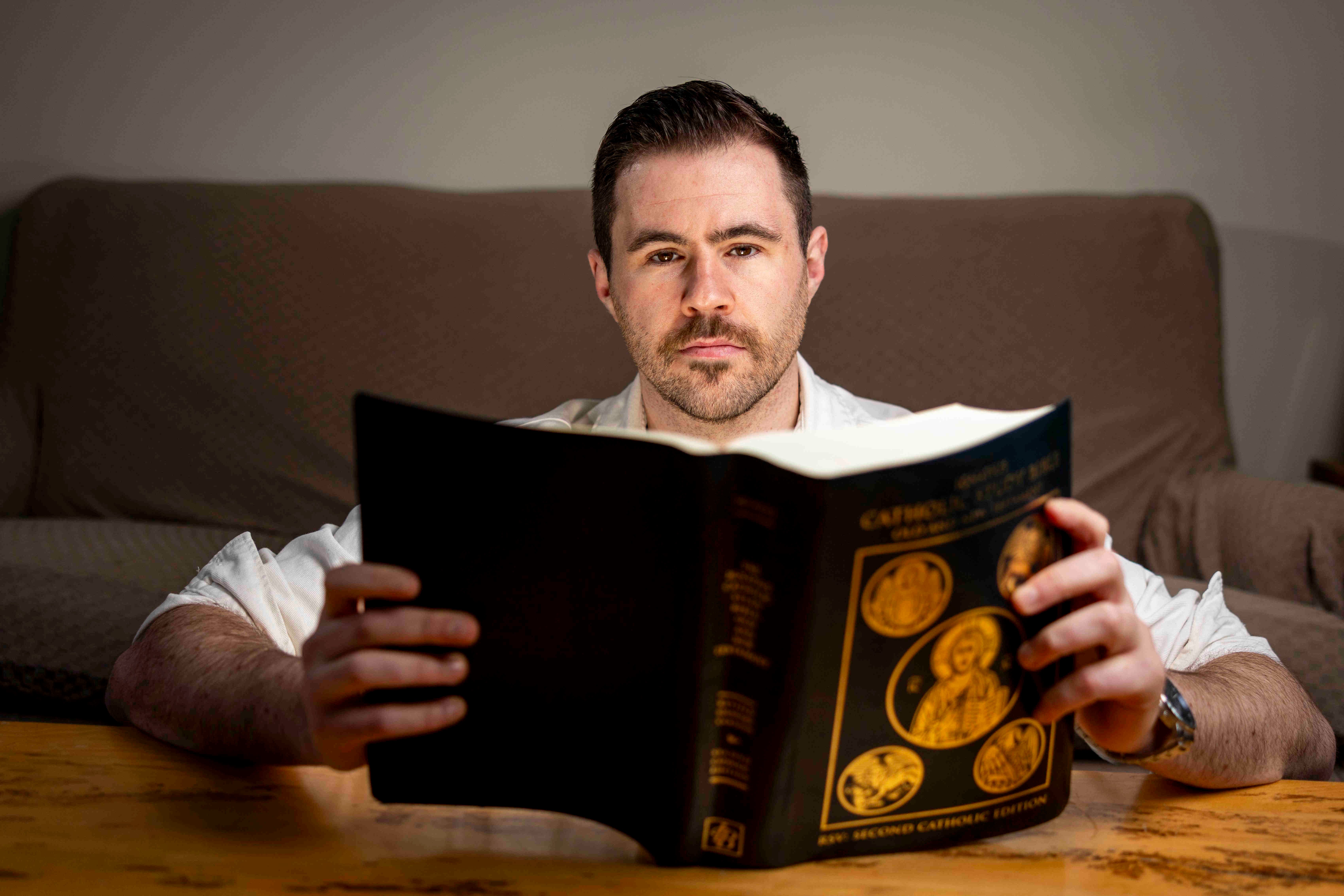
My Initial Doubts
When I set out to become a Catholic last year, I didn’t know what to expect.
Despite my acceptance of the Christian story, metaphysics and ethics, joining the Catholic Church as an Irish person was a whole level above (hence why I procrastinated getting baptised for the entirety of 2024). In my head I knew that the journey to God was not an intellectual exercise, and you had to participate in the sacraments and the life of the church to go on that journey. Yet, my heart was still divided on the church: the scandals, the stories of repression, death and decay – was it all a broken ruin worth turning your back on, like they said? And yet, to remain outside the church’s walls was to remain, in some sense, unfinished, like a spiritual Peter Pan?
The fact that finding a place to be baptised proved difficult and that the church had no standardised process for adults seeking baptism only compounded my doubts in early 2025 when I went seeking baptism – maybe this was not the true church? Surely the true church would have a big massive neon sign outside and pull you in like a magnetic tractor beam? And not be so difficult to join? Not to mention that when I did find a place to get baptised in Rathfarnham, and attended my first mass on that dreary January Wednesday morning, I was the only one in the pews below sixty years old.
That morning, I sloped down the back and sat by myself in the pew; that way, if the inspiration struck, the option was there to simply run out of the church and never come back again. But as the mass began and the rag-tag choir rose, composed of two elderly gentlemen in the front row, my soul was put at ease. The two men started a ghostly chant, and then the other parishioners broke in behind them, and the lilting melody of those aged Irish voices, melted away the icy fears that gripped my heart. Their faith, quiet as it was on that dreary Wednesday morning, shone through and moved me to the point of tears. I found that the spirit still burnt brightly in that humble place, and I concluded though scarred and wounded, embattled and bruised; the church was alive and singing.
Finding Faith and Faithlessness
Each time in the Catholic Church when I have opened a door expecting ruins and decay, I have found green growths of life and deep joy instead. My journey into the Catholic faith and the sacraments began with tension and trepidation, facing great resistance that blocked the bigger picture, like tunnelling through a cave with only the light of a lamp in front of you. But as the year has gone on, that narrow tunnel opened up into wider and wider caverns, filled with beauty and treasures and gold and rubies and gems and many others who were emerging from their respective tunnels, led by their own lights, to discover the same.
Throughout the year, there has been great joy in getting to know those who tend the treasures of the Catholic tradition and those who are just discovering them alike: the exuberant peace of a difficult confession, the feeling of Christmas day when queuing for communion, and the sound of a missing piece, one did not know one was missing, clicking into place. I came to the conclusion, it is this church and this tradition that is the heart modern Ireland is missing.
But this is where things get complicated again…
The joys of participating in the sacraments are like a delicious meal one has tasted, and so naturally, one wants to share the meal with other people. But unfortunately, what you learn then pretty quickly when you do try and share what you have discovered with others is that most people in Ireland hate the Catholic Church and religion in general (including Catholics). It’s a somewhat paralysing experience at first to find yourself suddenly transformed into the villain or a villain apologist in the unseen drama of another’s mind, when only a moment ago you were a friend or an ally. Paranoia can take hold, and it feels like a great chasm has opened between oneself and friends and family and modern culture and that you must now withdraw or exist on the margins or disappear completely.
It’s like one of those mythological stories, an inversion of Tír na nÓg, where you only walked into another room and then returned, but for everyone else, you’ve travelled a great distance and now stand on the opposite side of a gorge (’It’s like I don’t even know you anymore’). This is very hard to experience. You return with your excited news of a God still living, but those eyes that have not glimpsed the treasures for themselves regard you with the same story you did the church only a moment ago: the scandals, the stories of repression, death and decay, and a broken ruin worth turning your back on…
In my experience, after realising the absurd gap between the secular worldview and the sacred or sacramental worldview which I was participating in, one can get a sort of ‘world sickness’. The feeling of world sickness comes from being a convert and lurching between the secular and the sacred worlds like a seasick sailor. The two are so different you could end up with a kind of schizophrenia or a double life as a secular person and a practising Catholic under the cover of darkness – how do you marry up the two worlds? Is it even possible?
At first frequently, I was ranting and raving at people, arguing about complex theology and metaphysics over brunch and generally alienating people. This confusion even resulted in some sin on my part: bitterness and enmity in my heart, which I had to confess. When I went to confession, the priest asked me quizzically,
“Do you have cause to be around people like this often?”
And I had to laugh.
“Father, it’s the entire world that I live in…”
“That’s the way it is these days,” he explained.
The Need for De-Secularisation
A lot of the time this year, I felt yoked to two ships that were travelling in opposite directions. But like a dog with a bone, desperately I’ve been trying to find a bridge across this chasm to somehow reunite these two worlds so that they might even understand and talk sensibly to each other. In these attempts, and through the insight of Dr Zachary Porcu, I started to understand that prior to even considering joining the church, I’d undergone a long period of ‘de-secularisation’.
Through studying philosophy and the history of ideas, I’d been given a totally new set of categories to understand reality and through these new categories I was able to start grasping the sacred worldview, piece by piece. The problem is when you transition to a new worldview how quickly you forget the old one (and those who got you there, hence why Jordan Peterson was so easily defamed). Importantly, this de-secularisation took me over ten years! And I’m a pretty quick learner!
The vast majority of people that are part of the secular culture have not undergone this autodidactic ‘pre-catechism’ and so are working with an entirely different set of modern categories that preclude the sacred or sacramental worldview. So, I’ve started to chill basically and recognise that helping people firstly see the categories that are guiding their thinking and the alternatives and why the alternatives might be better than the former is deep and slow work that requires patience, understanding and compassion.
And importantly, this understanding has given me a kind of quiet underlying confidence because every bit of my mind was once composed of that secular worldview, and through pursuing the truth, I shed it like a snake shedding skin. I feel like I’ve run through this whole video game already and have then come back to people who are only at the beginning. Despite the many difficulties and the upward slope, if you persevere, I know where it ends: beyond modernity, with the capacity to grasp both the secular and the sacred worldviews.
In the meantime, there are many who are further along on this trajectory, who experienced the Jordan Peterson wave, symbolic world, Awakening from the Meaning Crisis etc., and so have de-secularised their minds enough to return to a living faith. And throughout the year, I’ve met more and more of these people who are being drawn by the light of truth, goodness and beauty in the great tradition. What at first seemed like only a few droplets has quickly become a stream and even at times threatens to turn into a roaring river. These prodigal sons and daughters are taking on a new apostolic mission to help the secular cross over from the derelict secular worldview, like they were helped themselves, and building many flotilla’s and channels and groups around this shared aim.
In quiet moments of great joy for me personally, the light in my own eyes has sparked enough curiosity in others to go and see the treasures for themselves, and then I get the great pleasure of seeing the light in their own eyes. Like the fading ripples of a pool made still, my own purpose has crystallised throughout this year as a go-between in this great transition or advent of the sacred, a philosophical ferryman of sorts, worldview middle management, who can attempt to stand in the tension between the secular and the sacred and hold a space for those who might cross.
Conclusion
If we had eyes to see and we could look up, we would see the cosmic wheels turning; we’d see we are in the lurch at the moment, coming down off a four-hundred-year binge on materialism that, in many places, is not yet over. The end of modernity will not be brief or clean, and the goods of the world will go on and on, but honestly, they aren’t all that good anyway. In that sense, the old saying is true: not all that glitters is gold. But also by contrast, not all that doesn’t glitter is not gold.
Modernity, if you will allow me to be reductive, is a critical age and has spent a great deal of time and intellectual resources heaping coal on the Catholic Church to dim the shine of its treasures. Therefore, as modern people, we see only through a glass darkly, dimly apprehending the glory of spiritual realities with our atrophied intellectual vision, like a light at the end of a dark tunnel that can be easily dismissed as an illusion or trickery. But as the soot comes off the great tradition, more and more will see the gold glittering and be called forth to participate in the supper of the Lamb. So you know, all hands to the wheel.
For all the grand narratives abounding for your attention at this transitory moment – transhumanism and the political and economic utopias – my vote goes to this ‘return to the roots’ paradigm. Not necessarily to go full Amish (although they might be onto something), but to return to your tradition with your newly minted bifocal vision: to be able to see both the secular and the sacred worldviews and thus participate fully in the deep moral transformation that is required of us: “Blessed are the pure of heart for they shall see God” (Mathew 5:8), but also start to establish thriving post-secular christian communities, oriented around proper values like love, family, community - wouldn’t that be something?
In brief, I wasn’t sure about the Catholic church particularly in Ireland but after one year of investigation and participation I don’t have those doubts anymore. Sure there are difficulties, under staffing and short-comings, but in my experience if you are humble and willing to take on responsibility, those are gaps which young people are actually there to fill (i.e starting prayer groups, bringing other young people in, building communities etc) - in short, and you can imagine reading this in a John F Kennedy accent; “ask not what your parish can do for you, but of what you can do for your parish”.
The real question is, are you going to take my word for it? Or the secular story of decline and degeneration? Or are you going to go and see for yourself? Run the experiment: one year of ‘catholic-maxxing’ and let me know what you think.
Great witness Mahon, and it was great to meet you in Maynooth at Easter. In the words of Our Lord, the Spirit blows where it listeth. It’s a real blessing to have you on the team 🙏🤝
Excellent piece, Mahon, and you described the tensions of our moment very well and eloquently. May all your days be of fruit and light.